How Kyyte developed the values, tone of voice and brand messaging for a global electronics recycling and reuse certification programme.
About e-Stewards.
e-Stewards is a global certification programme based in Seattle, USA, and created by the Basel Action Network (BAN), a US-based environmental justice organisation. Its work promotes responsible electronics recycling and reuse, bringing together certified recyclers, enterprises and other stakeholders committed to protecting people and the environment.
With a global network and an established reputation in its industry, e-Stewards needed a brand book that could communicate its purpose, values and standards consistently.
The challenge: bringing an established brand together.
e-Stewards had already developed important elements of its brand identity. Its new website provided a clear visual direction, including its colour palette, imagery, and overall look and feel.
The organisation also had a seven-page internal brand guide. It contained its mission, ten brand values, tone-of-voice principles, key messages and desired brand perception. However, much of this information existed as single words, short statements or lists.
For example,
- The values section identified words such as integrity, sustainability, accountability and collaboration without explaining what they meant to the organisation.
- Its tone-of-voice guidance included statements such as being technically authoritative but friendly, with little detail about how to apply those principles in everyday communications.
Kyyte’s brief was to develop a comprehensive brand book that brought these elements together and gave the organisation and its partners clearer guidance on how to communicate.
THE ORIGINAL BRAND GUIDE
7 pages
An established mission, visual identity, ten values and key messages, with limited supporting explanations.
Our approach: developing the brand from the inside out.
Rather than starting with a blank page, Kyyte worked with e-Stewards’ existing brand identity and website. We used the established visual elements as the foundation for the brand book, then concentrated on developing the written guidance.
This involved expanding the values, defining the tone of voice, explaining the key messages and documenting the desired brand perception. We also brought the visual elements together into a more detailed reference covering typography, colours, imagery and logo usage.
The biggest contribution was the copywriting. We developed the language that explained what e-Stewards stood for and how to express those principles.
1. Giving meaning to ten brand values.
The original brand guide presented ten values as individual words. They identified the qualities e-Stewards wanted to demonstrate but didn’t define them.
Kyyte developed a written explanation for each value, connecting it to the organisation’s work in ethical electronics recycling, its relationships with certified processors, and its responsibilities to the wider industry.
We also organised the values into five core values and five supporting values, making the information easier to navigate and understand.
From individual words to defined brand values
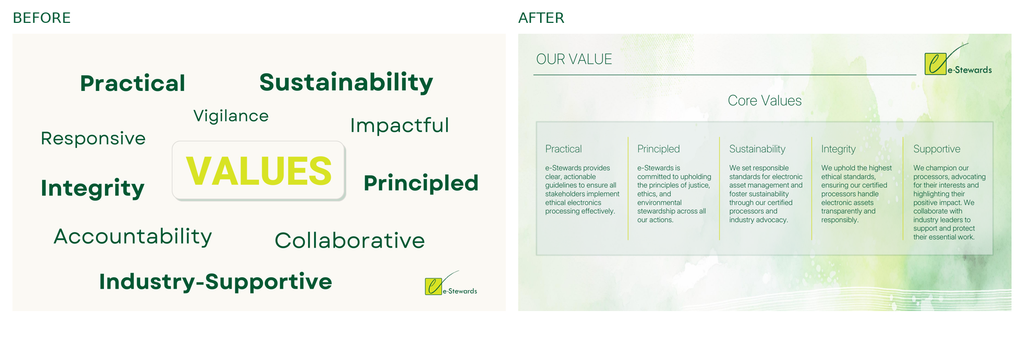
Before: Ten values displayed without explanations.
After: Individual definitions, organised into core and supporting values.
Take integrity as an example. The original document listed the word without further explanation. Kyyte developed a definition that connects it to ethical standards, transparency, and responsible handling of electronic assets.
We applied the same approach to the other nine values. Practical became a commitment to clear, actionable guidance, while supportive explained e-Stewards’ role in championing its processors and advocating for their work.
These descriptions gave the team a shared understanding of what each value represented and language they could use in future communications.
2. Turning tone-of-voice principles into writing guidance
The original brand guide identified five broad characteristics of the organisation’s voice. It wanted to sound authoritative yet friendly, be business-aware, communicate transparently and demonstrate a willingness to help.
Kyyte developed these principles into five defined communication styles, each with supporting explanations and examples of how to express them.
Five defined communication styles
| Authoritative and professional | Establishing credibility and communicating technical expertise. |
| Informative and educational | Helping audiences understand the risks of improper e-waste disposal and the benefits of certified processing. |
| Cautionary and responsible | Communicating environmental and ethical risks clearly. |
| Reassuring and solution-oriented | Explaining how e-Stewards certification helps address electronics recycling challenges. |
| Collaborative and business-aware | Recognising the needs of industry partners and encouraging cooperation. |
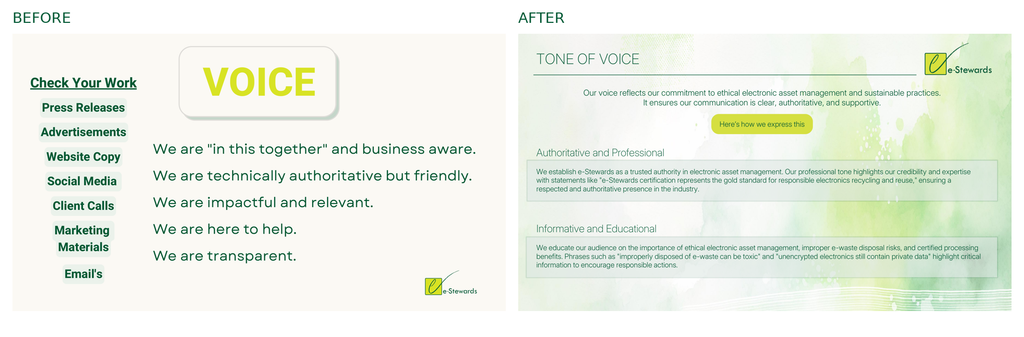
This section required particular care. e-Stewards needed to communicate the serious environmental and human consequences of irresponsible electronics recycling while maintaining constructive relationships with businesses and certified processors.
The expanded guidance helped establish how to communicate both sides of that responsibility.
3. Explaining the purpose behind every key message.
e-Stewards already had seven established key messages. These included environmental responsibility, data security, industry leadership and the importance of preventing hazardous e-waste exports.
Kyyte retained the existing messages and developed supporting copy to explain their meaning and intended use.
For example, the original guide included the statement, “We are here to help you shine”. The expanded brand book explained how e-Stewards helps businesses meet ethical standards and demonstrate leadership in responsible electronic asset management.
Similarly, the message “Do not export harm” was developed into an explanation of the risks associated with exporting hazardous electronic waste to developing countries.
Making existing messages more useful.
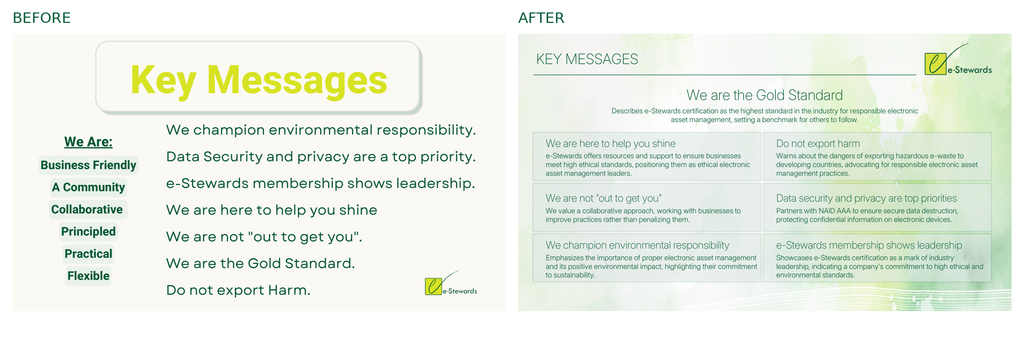
Original key message statements alongside the expanded explanations.
The expanded messaging provided greater context for the organisation’s marketing and communications. It also helped establish a common language for discussing its certification programme, environmental commitments and relationships with industry partners.
4. Developing the desired brand perception.
The original guide included an unusually candid assessment of how e-Stewards believed it had been perceived in the past, alongside the qualities it wanted to establish in future.
The desired attributes included being professional but friendly, service-oriented, responsive and an advocate for the industry.
Kyyte developed explanations for nine of these attributes, documenting what each meant in the context of the organisation.
From desired attributes to defined positioning.
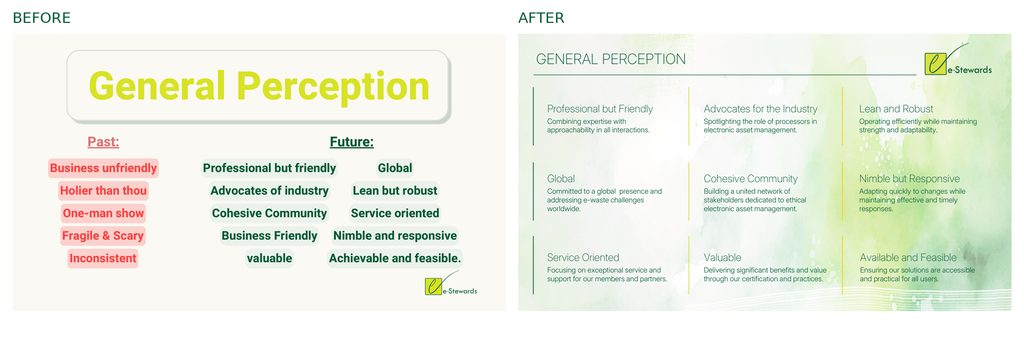
The original page identified past and future perceptions. The expanded version explains the desired attributes individually.
For instance, being an advocate for the industry was explained through e-Stewards role in recognising the work of electronics processors. Its ambition to be a cohesive community was connected to building a united network of stakeholders committed to ethical electronic asset management.
These descriptions gave the organisation a clearer foundation for communicating how it wanted to be understood by its members, partners and wider industry.
5. Bringing the visual identity into one brand book.
With the new website providing an established visual direction, Kyyte developed the brand book around e-Stewards existing identity.
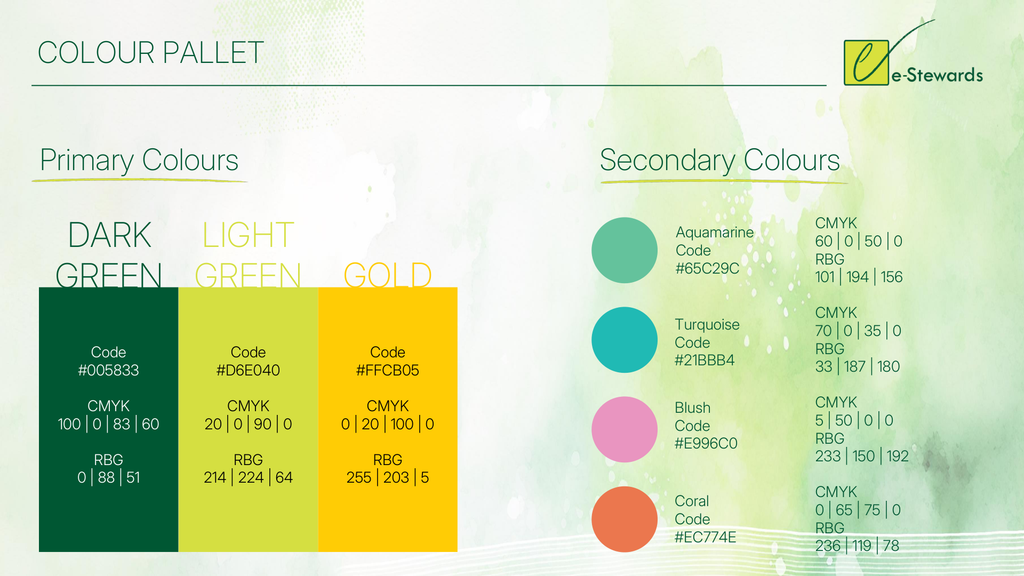
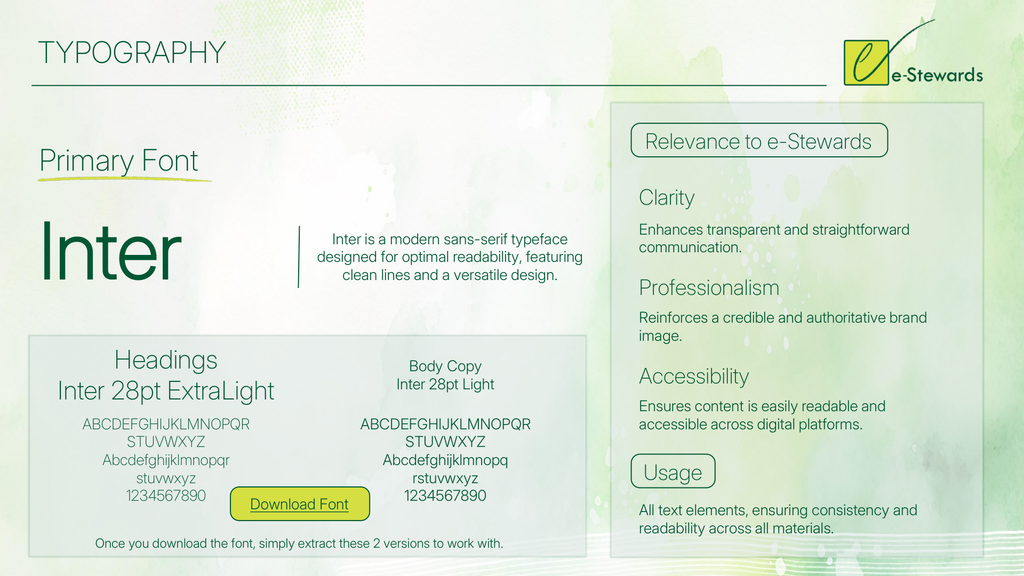
The expanded document included guidance on logo spacing and usage, primary and secondary colours, typography and imagery. It also explained the purpose of key visual elements, including the use of nature, electronic equipment and workers.
The colour section documented the relevant HEX, RGB and CMYK specifications, while the typography guidance established a consistent approach to headings, subheadings and body copy.
Together, these elements created a more detailed reference for applying the brand across digital and printed communications.
The expanded visual guidelines.
The result: a comprehensive 17-page brand book.
Original guide > Expanded brand book
7 pages > 17 pages
What Kyyte delivered:
- Ten individually defined brand values.
- Five developed tone-of-voice styles.
- Seven key messages with supporting explanations.
- Nine defined brand perception attributes.
- Expanded visual identity and design guidelines.
- Design and copywriting of a comprehensive brand book for internal and external communications.
The completed document brought together e-Stewards existing brand identity and the newly developed messaging in one resource. It gave the team a clearer understanding of the organisation’s values, how to communicate its purpose, and how to apply its brand consistently.
The client’s feedback confirmed the value of this work.
Google review, 9 May 2025
“Kyyte captured the essence of our brand and delivered a clear, thoughtful brand guidelines document.”
Daniel Puckett, e-Stewards
Helping sustainability organisations communicate their work.
This project demonstrates how Kyyte approaches brand messaging when an organisation already has an established identity but needs more detailed written guidance.
For e-Stewards, our work involved understanding its existing brand, developing its values and key messages, and documenting how the organisation should communicate with its audiences.
Kyyte provides brand awareness and messaging services for organisations that need to define their brand, develop their tone of voice or create practical guidelines for consistent communication.
We also work with sustainability-focused organisations through our ESG and sustainability communications services, helping them explain complex environmental and social issues clearly and accurately.
Need help developing your brand guidelines?
Whether you are establishing a new brand or developing an existing identity, Kyyte can help clarify your messaging, define your tone of voice and create guidelines your team can use.
Frequently asked questions about brand guidelines and messaging.
What should be included in brand guidelines?
Comprehensive brand guidelines typically cover a company’s mission, values, brand messaging, tone of voice and visual identity. They may also include logo usage, colour palettes, typography, imagery and practical examples of how to apply the brand across different communications. The aim is to give employees, agencies and other stakeholders clear guidance on representing the brand consistently.
What is the difference between brand guidelines and brand messaging?
Brand guidelines document how a business should present itself visually and verbally. Brand messaging focuses on what the business communicates, including its values, positioning, key messages and tone of voice. Together, they help businesses establish a recognisable identity and communicate consistently across their website, marketing materials and customer communications.
Can Kyyte develop brand guidelines for an existing brand?
Yes. You don’t need to start from scratch. Kyyte can work with your existing website, visual identity and marketing materials to develop or expand your brand guidelines. For e-Stewards, we used its established brand elements as the foundation, then developed detailed descriptions of its values, tone of voice and key messages. Explore our brand awareness services to learn more.
How can brand guidelines support sustainability communications?
Brand guidelines help sustainability-focused organisations communicate complex environmental and social issues clearly and consistently. Documenting key messages, terminology and tone of voice gives teams a shared reference for producing website content, reports, marketing materials and stakeholder communications. Kyyte’s ESG and sustainability communications services include developing messaging guidelines for organisations communicating their sustainability commitments and activities.
When should a business update its brand guidelines?
Consider updating your brand guidelines when your business changes its positioning, introduces new services, enters new markets or finds that its communications have become inconsistent. An update may also be worthwhile when your existing guidelines focus heavily on visual identity but offer little direction on messaging or tone of voice. As the e-Stewards project demonstrates, an established brand can benefit from more detailed written guidance without needing a complete rebrand.
Related reading.
How to build brand awareness that gets results
Explore how to establish a recognisable brand identity, develop consistent messaging and build awareness with your target audience.
Sustainability marketing and ESG communication
Learn how to communicate your organisation’s sustainability commitments, environmental progress and ESG activities through clear, credible content.