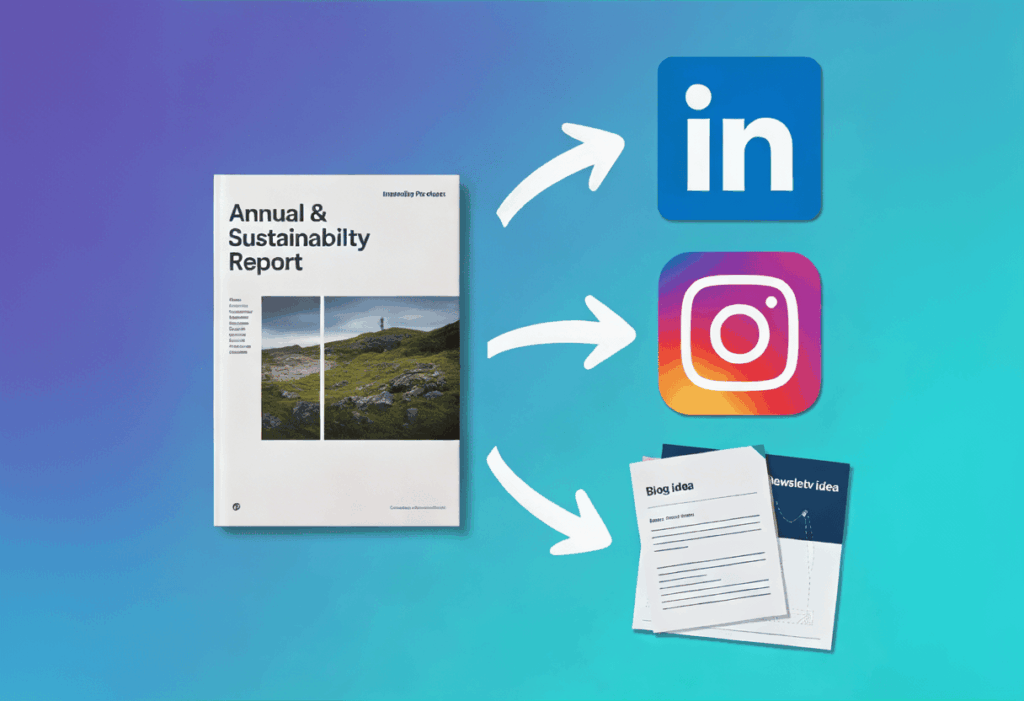
Why your report should not be the final step.
Why aren’t more companies repurposing their annual and sustainability reports? Most are treated as the finish line when they should be the starting point.
Months of work go into them. They are published, shared once, and then left behind as a static PDF.
I’ve seen this from both sides. As both a practitioner inside large organisations and now working with clients through Kyyte.
Earlier in my career, I worked in sustainability and corporate social responsibility across community programmes, workplace giving, and volunteering initiatives at Optus (an owned subsidiary of Singtel) and the Vodafone Foundation, and I put significant effort into delivering meaningful impact.
The reports captured what was delivered, and we tracked the progress continuously throughout the year.
But the real value came from what happened next.
The stories behind those programmes:
- The people involved
- The partnerships formed
- The outcomes achieved
- Teams got involved
When those were shared properly, they drove:
- Employee engagement
- Internal pride
- Stronger brand perception
That same pattern still exists today.
ALL companies already have the content they need sitting inside their reports:
- Leadership thinking
- Employee stories
- Customer impact
- Verified data
- Future commitments
In other words, some of the most valuable content a business produces all year.
AND it has all been signed off and approved already.
But without a clear approach to how that content is used, much of its value is never realised.
That is where a structured approach to sustainability content and ESG communication becomes important.
The difference is how it is used.
Leading organisations are not just publishing reports. They are using them as a content marketing engine.
Here are seven ways to do it properly, using real examples from Singapore companies.
1. Turn leadership messages into a thought leadership series.
Annual reports always include CEO and leadership messages. These are carefully written, approved, and aligned to business strategy.
Instead of leaving them inside a report, they can be repurposed into:
- LinkedIn articles
- Leadership posts
- Media commentary
For example, DBS(1) uses its reporting to articulate its position on sustainable growth across Asia. These themes can easily be extended into executive commentary and industry perspectives.
Why this works:
Leadership voice builds credibility. You are not creating new ideas. You are extending what has already been approved at the highest level.
2. Turn workforce data into internal storytelling.
Many reports include diversity, training and workforce insights, but they are rarely used beyond compliance.
For example, OCBC reported(2) that women held 42% of leadership roles in its 2024 sustainability report.
That single data point can become:
- Internal articles on female leadership journeys
- Employee spotlight series
- Recruitment content
This is where your idea fits perfectly.
Instead of saying “42% of leadership is female”, the stronger story is:
- Who these leaders are
- How they progressed
- What others can learn
This turns a statistic into a narrative.
Workforce data can also support employee engagement and internal communication content, including leadership updates, employee features and recognition campaigns.
3. Turn employee development programmes into content.
Reports often contain detailed information about:
- Training programmes
- Leadership pathways
- Reskilling initiatives
For example, UOB reported(3) that its Leadership Acceleration Programme led to 121 promotions between 2020 and 2024.
That can become:
- A feature on career progression
- An internal “how people grow here” article
- Employer branding content
Why this matters:
This is content candidates actually care about. It is also backed by real outcomes.
4. Turn community and volunteering programmes into stories.

This is one of the most underused areas.
Reports often include:
- Volunteer hours
- Community partnerships
- Workplace giving
But they are usually presented as numbers.
For example, Singtel reported(4) on volunteer programmes in which employees helped seniors and members of the public build digital skills and improve online safety awareness.
That can become:
- Human stories about the people involved
- Employee-led content
- Community impact features
This is where experience matters.
From my time at Optus and the Vodafone Foundation, I learned that volunteering programmes were never just metrics.
The real value came from:
- The people participating
- The partnerships formed
- The stories created on the ground
Those stories drove:
- Employee engagement
- Internal pride
- External brand perception
The report captures the outcome. The content brings it to life.
You can also read our sustainability marketing blog.
5. Turn ESG data into visual and social content.
Reports are full of:
- Emissions data
- Targets
- Performance metrics
For example, City Developments Limited reported(5) a 25% reduction in Scope 1 and 2 emissions relative to 2016 levels, along with significant reductions in embodied carbon in new developments.
Instead of leaving this in a report:
- Turn it into an infographic
- Create visual dashboards
- Build social content around progress
Why this works:
Data builds trust, but only if people can understand it quickly. This is where clear communication of ESG data becomes critical.
6. Turn sustainability initiatives into case studies.
Most reports include:
- Project highlights
- Initiatives
- Impact summaries
This content can be repurposed into:
- Website case studies
- Sales materials
- Client-facing content
- Sustainability storytelling that shows real impact
For example, OCBC’s Women Unlimited Programme(2), which has extended funding to women-led businesses in Singapore, includes real founder stories.
That can become:
- A customer success story
- A feature on entrepreneurship
- A brand-led narrative around impact
This is high-value content because it shows real outcomes rather than claims, and you can use it to create content that drives lead generation.
7. Turn report content into SEO-driven website pages.
This is where most companies miss the biggest opportunity, especially when they lack a clear approach to content repurposing strategies.
Reports are often published as PDFs, which:
- Limit visibility in search
- Are harder to navigate
- Are rarely updated
Instead, key sections can become:
- Sustainability strategy pages
- ESG framework pages
- Impact reporting pages
This improves:
- Search visibility
- Accessibility
- Ongoing content performance
It also allows content to evolve over time, rather than being locked into a single annual document.
An example worth sharing:
Mapletree Investments(6) presents its sustainability approach through a dedicated website section rather than relying solely on its sustainability report.
On its sustainability overview page, the company outlines:
- Its sustainability framework across economic, environmental, social and governance pillars
- Key material topics aligned to stakeholder impact
- Headline performance metrics such as green financing, renewable energy capacity, and workforce representation
This lets users quickly understand Mapletree’s sustainability strategy without navigating a full report.
Key information is:
- Structured and easy to access
- Broken into clear sections
- Supported by data and ongoing updates
The missed opportunity sitting in every annual and ESG report.

Most organisations already have the content they need.
It sits inside annual and sustainability reports:
- Leadership thinking
- Workforce insights
- Customer impact
- Verified data
The issue is not a lack of content.
Companies treat these assets as static documents instead of active content sources.
Companies that get more from their reports aren’t creating more. They extract more and build brand awareness through content that keeps delivering over time.
From report to content marketing engine.
An annual and sustainability report should not mark the end of a process.
It should be the starting point.
Because when used properly, one report can support months of content across:
- Marketing
- Internal communications
- Employer branding
- Stakeholder engagement
This includes repurposing your sustainability report into content marketing that keeps engaging audiences long after publication.
From leadership storytelling to employee features, from ESG data to real-world case studies, the material is already there.
It just needs to be used differently.
Closing reality.
If your report is sitting on your website as a PDF, you’re using only a fraction of its value.
The rest is still waiting to be turned into something people will actually read, engage with, and remember.
Repurposing annual and sustainability report FAQs.
What does it mean to repurpose an annual or sustainability report?
Repurposing means taking useful material from a published report and adapting it for other formats and audiences. A leadership message might become a LinkedIn article, workforce data could support an employee story, and an environmental initiative could become a website case study. The source remains the same, but the presentation, length, and context change depending on where the new content will appear.
Which parts of a sustainability report are best for repurposing?
Start with information that has a clear audience, credible evidence and a useful story behind it. Strong possibilities include leadership commentary, progress against targets, employee initiatives, community partnerships, customer outcomes and individual projects. A long table of data may have limited value on its own. One significant result, supported by context and an explanation of how it was achieved, can produce much stronger content.
Does repurposed sustainability content need to be approved again?
Usually, yes. The report provides an approved source, but changing the wording or removing information from its original context can affect how a claim is understood. Repurposed content should be checked by the relevant sustainability, legal, compliance or communications teams. The review should confirm that the data, reporting period, methodology, and limitations are still accurately represented.
How can companies avoid greenwashing when repurposing report content?
Keep every claim tied to evidence in the published report. Include the reporting period, explain what the figures measure and retain any qualifications needed to understand the result properly. Avoid turning limited progress into a sweeping sustainability claim. If an initiative applies to a single market, business unit, or product, the content should state so. Precise language is more credible than an impressive headline that the underlying evidence cannot fully support.
How long can content from an annual or sustainability report be reused?
There is no fixed expiry date, but the information must remain accurate and clearly dated. Leadership perspectives, employee stories and project case studies may stay relevant for years. Performance figures and progress updates can become outdated once a newer reporting cycle is published. Create a record of which report and reporting period support each content asset. When new data becomes available, review the content and update, archive, or replace anything that could mislead readers.
Get more from the report you have already created.
If you’re not getting enough value from your report, the issue, in my opinion, is not the content itself.
It’s how much you’re doing with it after it’s published.
Kyyte’s sustainability report repurposing and communications services help organisations identify the leadership thinking, employee stories, verified data, and stakeholder content already approved within annual and sustainability reports.
Send your latest annual or sustainability report to Kyyte, and we’ll show you how much more content you could be creating from it.
Reports referenced.
Below are the reports referenced in this article. Each example reflects publicly available information from the most recent reporting cycles.
- DBS Annual Report 2024
- OCBC Sustainability Report 2024
- UOB Sustainability Report 2024
- Singtel Sustainability Report 2024
- City Developments Limited Integrated Sustainability Report 2024
- Mapletree Investments